 thingiverse
Garden Spacer
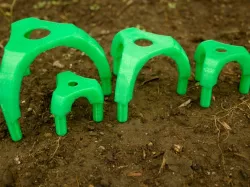
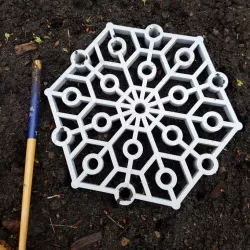
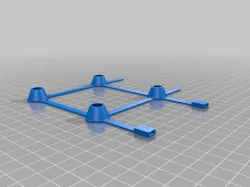
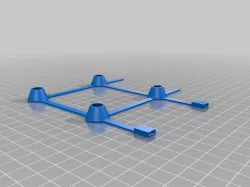
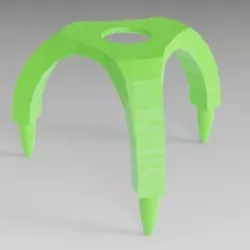
This is a manual spacing tool for sowing seeds at different spacings in a hexagonal pattern.
This pattern has many benefits, including higher density of crop grown per square foot, the plants themselves do a better job of choking out weeds, the tighter foliage shades the ground which keeps it cooler and moister, requiring less watering.
Here you can see how the spacing works in the complex case of companion planting multiple things together, but it also applies to the simpler case of a single crop, for which these tools were designed: http://organic.kysu.edu/CompanionSpacing.shtml
For more information about the method, and a natural, holistic gardening method, check out this book: How to Grow More Vegetables by John Jeavons - http://www.amazon.com/gp/product/B001U6KIPA/ref=as_li_ss_tl?ie=UTF8&tag=engfamfar-20&linkCode=as2&camp=1789&creative=390957&creativeASIN=B001U6KIPA
In the photos, you can see a top-down view of a patch of radishes planted with this sort of spacing (2 inch), and a couple of radishes just harvested from that patch. You can see how dense, but evenly spaced the plants are (save for one here and there that didn't come up).
You can also find a little bit more of a write-up with some info on a couple other printable garden accessories here: http://www.protoparadigm.com/2012/05/what-to-do-with-a-3d-printer-make-garden-tools/
Instructions
I have released STL files for spacers with 1.5 inch, 2 inch, 3 inch, and 4 inch spacing. If you're unfamiliar with openSCAD and want a different size, let me know and I'll add it.
Print and use.
To use these tools, press into the soil to make the holes, then move the tool so that two of the prongs are in two of the existing holes, and press down to make the third whole. After the first time, each time you use it, you'll only be making one new hole, but doing this ensures you'll get a uniform spacing pattern. After you've made the holes, drop in your seeds and lightly brush soil in over the holes with your hand.
You'll have to look on your seed packet (or in the charts in the book linked to in the description) to see how the plants should be spaced. It depends on the habit of the plant, but generally speaking, you'll want to space your seeds a little further apart than the in-row spacing listed on a seed packet. For root vegetables like carrots, radishes, turnips, etc., or small leafy plants like lettuce, you may be able to use the in-row spacing.
Direct link to the original creator's page
Also Available On
More from alexenglish
Similar Models

Model Specifications
Frequently Asked Questions
How do I download Garden Spacer?
Click the "View on thingiverse" button above to visit the original model page on thingiverse. You can download the STL file directly from the creator's page for free.
What 3D printer can I use for this model?
This STL file is compatible with most FDM 3D printers (Creality Ender 3, Prusa MK3S+, Bambu Lab, etc.) and resin printers (Elegoo, Anycubic). Check the original page for recommended print settings and materials.
Is this 3D model free to download?
Yes, this model is available as a free download on thingiverse. Some creators accept tips or donations.
Can I modify this STL file?
Most STL files can be modified using free software like Blender, TinkerCAD, or Meshmixer. Check the license on the original thingiverse page to see if modifications are permitted by the creator.