 GrabCAD
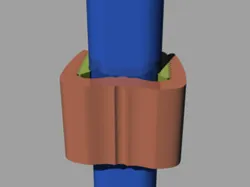
Handrail Clamp keyhole
Emphasis has been on printing without support material. So that no time has to be spent on the removal of support material and post processing. Astronaut time will not be charged by additional work.
Clamping force is distributed over several teeth, instead of on one snap edge. This enables them to be made smaller instead of one large clamping edge. Backside provides a spring action which provides tension on the teeth, and also increase friction with frame. And this is also a prevention against slippage.
Compactor and stronger design version was a second point for improving this design. This is achieved by moving the slot to the side of the rail. Structural strength is added by capping off one side of the bolt slide. Bolt can still be added from the other side.
Material usage. There are lots of different infill patterns that you can use, and at different densities. Each pattern has a tradeoffs between weight, strength, printing time. Difficult to estimate at this time.
https://www.nasa.gov/centers/marshall/news/nasa-selects-winning-space-station-handrail-designs-for-grabcad-challenge.html
Direct link to the original creator's page
More from Mart Berghs


Similar Models


Model Specifications
Frequently Asked Questions
How do I download Handrail Clamp keyhole?
Click the "View on GrabCAD" button above to visit the original model page on GrabCAD. You can download the OTHER, RENDERING, STEP / IGES, STL file directly from the creator's page for free.
What 3D printer can I use for this model?
This model is compatible with most FDM 3D printers (Creality Ender 3, Prusa MK3S+, Bambu Lab, etc.) and resin printers (Elegoo, Anycubic). Check the original page for recommended print settings and materials.
Is this 3D model free to download?
Yes, this model is available as a free download on GrabCAD. Some creators accept tips or donations.
Can I modify this file?
Check the license (see original page) on the original GrabCAD page. Most STL files can be modified using free software like Blender, TinkerCAD, or Meshmixer.