 GrabCAD
Hydrogen-powered Autonomous Vehicle
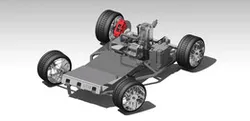
The CAD project created in CATIA V5 represents an Autonomous Vehicle, designed for the purpose of disabled individual’s transportation. Constructed from scratch, every component was implemented with an emphasis on attention to detail.
The vehicle contains a 400cc, twin-cam, one-cylinder, hydrogen-powered, 4-stroke combustion engine with 4 valves per piston. Furthermore, the vehicle assembly is constructed out of a 40mm steel tubular chassis. The additional components resemble rear and front axles connected rigidly onto the kart, on which a functional steering system and brake mechanism are bolted, allowing, in theory, the vehicle to function according to the requirements. The wheelchaired individual has access to the vehicle through an electronically actuated door mechanism. The wheels attached are designed to provide the kart a good contact patch with the road allowing it to have good handling characteristics. The overall weight of the vehicle is estimated to be around 310 kg with the addition of standardised bolts and hardware.
The creation process of this assembly has illustrated many difficulties for the designing team, but with hard work and perseverance, the autonomous vehicle project has been completed successfully within a time constraint of two months. Besides using CATIA as the main software, other computer programs have been utilised in order to optimise the performance of the vehicle. For instance, Ansys was used in order to analyse the stress, strain and deformation parameters for the Connecting Rod, in order to improve the strength of the component and increase performance and reliability values. Furthermore, CAM modelling using Autodesk Powermill in order to create a future possibility in which the connecting rod can be machined out of a solid alloyed steel billet.
All of these resemble the outcome that has been worked on thoroughly, in order to provide the product in a timely manner and allow for the finalised design to perform according to the initial requirements. The autonomous part of the assembly resembles a minor amount of representative sensor which transmits data to the electronically actuated brake, throttle body and steering mechanism.
As a result, the autonomous vehicle was finalised in a joint partnership with Anna Starostka and Robert Jakabos.
Direct link to the original creator's page
Similar Models
 GrabCAD
 Sketchfab
 GrabCAD
 GrabCAD
 Thingiverse
 3DExport
 GrabCAD
 GrabCAD
Model Specifications
Frequently Asked Questions
How do I download Hydrogen-powered Autonomous Vehicle?
Click the "View on GrabCAD" button above to visit the original model page on GrabCAD. You can download the RENDERING, STEP / IGES file directly from the creator's page for free.
What 3D printer can I use for this model?
This model is compatible with most FDM 3D printers (Creality Ender 3, Prusa MK3S+, Bambu Lab, etc.) and resin printers (Elegoo, Anycubic). Check the original page for recommended print settings and materials.
Is this 3D model free to download?
Yes, this model is available as a free download on GrabCAD. Some creators accept tips or donations.
Can I modify this file?
Check the license (see original page) on the original GrabCAD page. Most STL files can be modified using free software like Blender, TinkerCAD, or Meshmixer.