 cults3d
Knot-style Parametric Function Script ( Python )
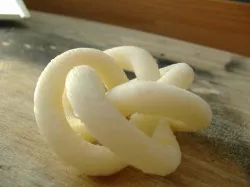
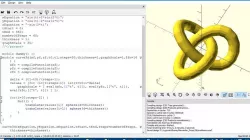
In my ongoing quest to eliminate or supersede all things Matlab, I present a functional solution to the problem of extruding along arbitrary contours, written in python.
This is a reaction to http://www.thingiverse.com/thing:7080, itself a derivative of http://www.thingiverse.com/thing:6923. Credit to both these authors for the concept and motivation.
Parameters are specified at the top of the script. A closed curve in 3D is specified as f:t→(x,y,z) a parametric function of t. A closed curve in 2D is specified as f:s→(x,y) and is used as the cross-section to extrude along the 3D curve.
Bonus : If you manually specify the "crosssection" matrix, which is a lost of [x,y] points around the perimeter, you can extrude arbitrary cross-sections.
download, cut, edit, steal, modify, repost, use, go.
update : I added knot.py, which simply explicitly defines the knot equations at the top and adds a couple integer parameters, similar too http://www.thingiverse.com/thing:6923.
Direct link to the original creator's page
More from lenanovelti

Similar Models
 thingiverse
 cgtrader
 cults3d
 thingiverse
 thingiverse
 thingiverse
 thingiverse
 cults3d
Model Specifications
Frequently Asked Questions
How do I download Knot-style Parametric Function Script ( Python )?
Click the "View on cults3d" button above to visit the original model page on cults3d. You can download the STL file directly from the creator's page.
What 3D printer can I use for this model?
This STL file is compatible with most FDM 3D printers (Creality Ender 3, Prusa MK3S+, Bambu Lab, etc.) and resin printers (Elegoo, Anycubic). Check the original page for recommended print settings and materials.
Is this 3D model free to download?
This is a premium model priced at on cults3d. Premium models often include higher detail, multiple parts, and print-tested files.
Can I modify this STL file?
Most STL files can be modified using free software like Blender, TinkerCAD, or Meshmixer. Check the license on the original cults3d page to see if modifications are permitted by the creator.