 Thingiverse
LayerStack printer layer stacking test
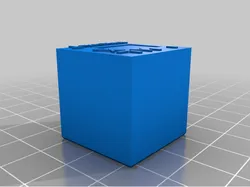
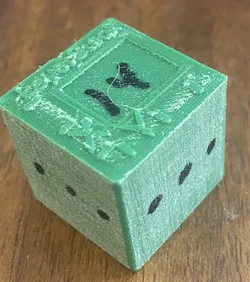
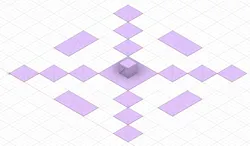
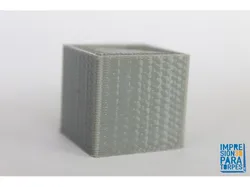
This is a semi-objective test to determine your printers accuracy in laying down layers on top of each other. It's useful to compare printers and especially to determine if changes to your printer make layer stacking better.The general procedure is to print a test cube and sand down one of the x sides and one of the y sides until all layer lines are scuffed. A measurement of the amount removed using a micrometer or calipers and a little math determines a LayerStack score.Procedure:Slice and print layerstack_cube.stl. Slicer settings are given below.Measure and write down the distance across the cube, 1/2 way up, aligned with the three marks along X and Y, yielding 6 numbers. See picture for a cube marked with the points to measure.Using 240 grit sandpaper on a smooth surface (a mirror works well), drag the cube on the X face across the sandpaper across the layer lines. Rotate the cube 180 for each pass so you don't favor one side or the other. Continue until the face is smooth and layer lines aren't visible. Repeat for the Y face.Remeasure at the same points.Subtract to compute the amount removed from each of the 6 numbersTake average of 6 numbers and multiply that by -100. That's your LayerStack score. Lower is better.To keep things consistent, you should slice the cube with PrusaSlicer (definitely do not use Kiss - it rounds corners and "cheats"). Use a 0.4mm nozzle and the following settings:Layer Height: 0.2Layer Width: 0.44Perimeters: 4Top Layers: 3Bottom Layers: 2Detect Thin Walls: TRUESeam Position: RearInfill: 10%Infill Pattern: RectilinearInfill Angle: 45Infill Before Permiters: FALSEExternal Perimeters First: TRUESpeed: 60mm/s for Perimeters and External Perimeters (for LayerStack60). Filament/Slowdown if print time less than 0 seconds (Important!)Acceleration, what you normally print with. Higher acceleration will lead to higher Layerstack scores. Here's a sample run:Original X: 24.035 24.018 24.053Original Y: 24.12 24.048 24.090Sanded Y: 24.016 23.969 24.015Sanded Y: 24.059 24.003 24.020Delta X: -0.019 -0.049 -0.038Delta Y: -0.061 -0.045 -0.070Mean: -.047---> LayerStack60 Score: 4.7The lowest LayerStack100 score I have seen is 3.2 on CroXY, my self designed cross gantry printer. My Ultibots D300VS delta printer scores hover around 6. CroXY info here: CroXYYou can also run the test at other speeds, I also run a LayerStack60 and LayerStack150I have included a spreadsheet I use to make scoring the LayerStack easier. It was authored in Google Sheets and should import without issue. I have not tested it on Microsoft Excel, but it should also work there. Note that I used a different endpoint on the spreadsheet so ignore the scores there. The spreadsheet also says to use 2 perimters. Use 4.
Direct link to the original creator's page
Also Available On
More from wesc


Similar Models
Model Specifications
Frequently Asked Questions
How do I download LayerStack printer layer stacking test?
Click the "View on Thingiverse" button above to visit the original model page on Thingiverse. You can download the STL file directly from the creator's page for free.
What 3D printer can I use for this model?
This model is compatible with most FDM 3D printers (Creality Ender 3, Prusa MK3S+, Bambu Lab, etc.) and resin printers (Elegoo, Anycubic). Check the original page for recommended print settings and materials.
Is this 3D model free to download?
Yes, this model is available as a free download on Thingiverse. Some creators accept tips or donations.
Can I modify this file?
Check the license (see original page) on the original Thingiverse page. Most STL files can be modified using free software like Blender, TinkerCAD, or Meshmixer.