 NIH 3D
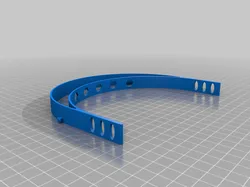
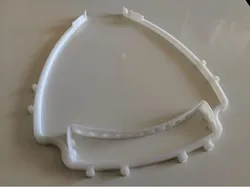
Lightweight A4 faceshield
Lightweight faceshield/visor frame that uses a standard A4 transparent sheet as visor (e.g. PVC report covers, acetate sheets, PET sheets, etc.).
Might be customisable for non-ISO sheet formats (send me specifications of sheets and hole punch).
Can help user reduce exposure to splashes, aerosols and droplets (WARNING: NOT a certified medical device, use at own risk, see DISCLAIMER at end of summary).
Designed as an attempt to minimise filament usage/print time and to use commonly available materials for visors (as opposed to thick, laser-cut shields).
Tested with 0.15mm and 0.25mm thick visors.
PRINT SUGGESTIONS:
Print in PLA/PLA+ with 0.3mm layer thickness. Avoid brittle materials.
Print time is around 30 minutes at 75mm/s.
Consider using large bore nozzles (1mm) to decrease print time - if the slicer can support single wall perimeters without jagging. A version with half the wall thickness should be strong enough for use but have not been able to print it (due to the slicer inducing jagged perimeters).
Ensure good adhesion (increase 1st layer temperature, reduce 1st layer speed and/or reduce nozzle gap if necessary) but use of rafts and contacting skirts should be avoided as this increases print time and filament consumption.
The designs includes small "winglet" features to increase the contact area where warping and model detach are more likely to occur.
ASSEMBLY:
Visor is perforated using a standard A4 4-hole punch (office/stationery type) on the long side, then "clicked" in position (no glue or other implements required).
Slide the edges of the sheet into the side guides before clicking-in the peripheral holes.
If printed correctly, the sheet should stay in position without play and with virtually no gap between the visor and the frame.
Trim bottom angles of visor as required. Can also use an A3 sheet (punched on the short side) for enhanced cover.
Visor is tightened behind the head with a single rubber band.
NOTES:
Carefully remove burrs and stringing before wearing - they hurt!
If wearing directly on the skin (without a protective cap or similar), use of self-adhesive foam on the forehead-facing surfaces is suggested for wearer's comfort.
DISCLAIMER:
This is NOT a certified medical device. Use at own risk. Always consult qualified medical personnel/contamination specialists before contact with infectious or suspected infectious patients. No formal cleaning/decontamination procedures have been developed for this faceshield.
This faceshield is NOT designed to provide any sort of impact protection and is not meant for DIY, airsoft or similar.
Always act safely, sensibly and responsibly!
Direct link to the original creator's page
Also Available On
More from AC88

Similar Models



Model Specifications
Frequently Asked Questions
How do I download Lightweight A4 faceshield?
Click the "View on NIH 3D" button above to visit the original model page on NIH 3D. You can download the GLB, JPEG, JPG, PNG, STL, WRL, X3D file directly from the creator's page for free.
What 3D printer can I use for this model?
This model is compatible with most FDM 3D printers (Creality Ender 3, Prusa MK3S+, Bambu Lab, etc.) and resin printers (Elegoo, Anycubic). Check the original page for recommended print settings and materials.
Is this 3D model free to download?
Yes, this model is available as a free download on NIH 3D. Some creators accept tips or donations.
Can I modify this file?
Check the license (CC-BY-NC-SA) on the original NIH 3D page. Most STL files can be modified using free software like Blender, TinkerCAD, or Meshmixer.