 NIH 3D
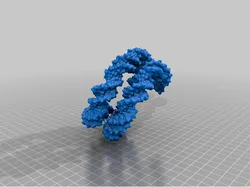
Nucleosome - multicolor version
Surface model of a complex between the nucleosome core particle and a 146 bp long DNA fragment (PBD ID 1AOI). The DNA should be printed in flexible TPU while the histones core in rigid PLA. The flexible material allows for the DNA fragment to be coiled around the core to recreate the complex.created for the Biochemistry and Structural Biology class and to respond to the following Biomolecular visualization learning goals (BioMolViz; DOI:10.1002/bmb.20991)MA1.01 Students can identify individual biomolecules in a macromolecular assembly. (Novice, Amateur, Expert)MA1.02 Students can describe the functions of individual biomolecules within a macromolecular assembly. (Novice, Amateur, Expert)
Direct link to the original creator's page
More from NIH 3D Designer


Similar Models
 NIH 3D
 Thingiverse
 NIH 3D
 NIH 3D
 NIH 3D
 NIH 3D
 NIH 3D
 NIH 3D
Model Specifications
Frequently Asked Questions
How do I download Nucleosome - multicolor version?
Click the "View on NIH 3D" button above to visit the original model page on NIH 3D. You can download the 3MF, GLB, JPEG, JPG, MTL, OBJ, PNG, STL, WRL, X3D file directly from the creator's page for free.
What 3D printer can I use for this model?
This model is compatible with most FDM 3D printers (Creality Ender 3, Prusa MK3S+, Bambu Lab, etc.) and resin printers (Elegoo, Anycubic). Check the original page for recommended print settings and materials.
Is this 3D model free to download?
Yes, this model is available as a free download on NIH 3D. Some creators accept tips or donations.
Can I modify this file?
Check the license (CC-BY-NC) on the original NIH 3D page. Most STL files can be modified using free software like Blender, TinkerCAD, or Meshmixer.