 GrabCAD
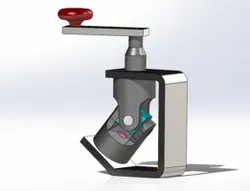
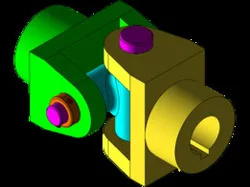
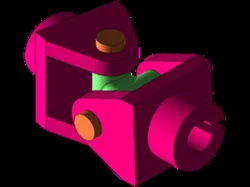
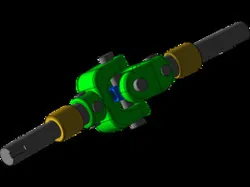
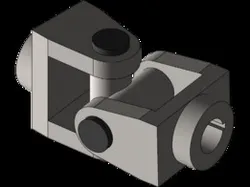
Universal joint coupling
A universal joint coupling, also known as a U-joint or Cardan joint, is a mechanical connection between two rotating shafts which are generally inclined to each other. It allows for the transmission of rotary motion and torque even when the shafts are not in a straight line. Here are the key aspects and characteristics of a universal joint coupling:
### Structure and Components
1. **Cross-shaped Center Piece**: The central component is a cross or "spider" with four arms.
2. **Bearing Caps**: Each arm of the cross fits into a bearing cap, which allows the cross to rotate within the yokes.
3. **Yokes**: Two yokes, each connected to one of the shafts. The yokes hold the bearing caps and enable the transfer of rotational motion between the shafts.
### Functionality
- **Flexibility**: The universal joint allows for flexibility in the alignment of the shafts. It can accommodate angular misalignment between the input and output shafts.
- **Torque Transmission**: Despite the angular displacement, the U-joint efficiently transmits torque from one shaft to the other.
- **Constant Velocity**: In an ideal condition, the output shaft rotates at a constant speed relative to the input shaft. However, in a single U-joint, the output shaft's speed can vary cyclically if the input shaft rotates at a constant speed. This can be mitigated by using a double U-joint or a constant velocity joint (CV joint).
### Types of Universal Joint Couplings
1. **Single Universal Joint**: Consists of a single cross-shaped center piece connecting two yokes. It can handle angular misalignment up to 45 degrees.
2. **Double Universal Joint**: Consists of two single joints with an intermediate shaft. This design can handle larger angular misalignments and provides more uniform rotational speed, mimicking the behavior of a constant velocity joint.
3. **Ball and Socket Universal Joint**: Uses a ball and socket mechanism to provide flexibility, commonly used in applications requiring low torque transmission.
### Applications
- **Automotive**: Widely used in drive shafts to transmit torque from the engine to the wheels, allowing for suspension movement and steering.
- **Industrial Machinery**: Employed in various machinery to connect parts that require flexibility in alignment, such as conveyor belts, pumping systems, and robotics.
- **Aerospace and Marine**: Utilized in systems where robust and reliable torque transmission is crucial, despite misalignments.
Direct link to the original creator's page
Also Available On
More from Karan srivastava
Similar Models

Model Specifications
Frequently Asked Questions
Where is Universal joint coupling published?
This model is published by its creator on GrabCAD. STLFinder only indexes it: the "View on GrabCAD" button above opens the original page, where the creator shares the RENDERING, SNAGIT, SOLIDWORKS files under their own license.
What 3D printer can I use for this model?
This model is compatible with most FDM 3D printers (Creality Ender 3, Prusa MK3S+, Bambu Lab, etc.) and resin printers (Elegoo, Anycubic). Check the original page for recommended print settings and materials.
Is this 3D model free?
Yes, the creator shares it at no cost on GrabCAD. Some creators accept tips or donations.
Can I modify this file?
Check the license (see original page) on the original GrabCAD page. Most STL files can be modified using free software like Blender, TinkerCAD, or Meshmixer.