 GrabCAD
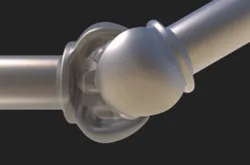
Weiss Joint
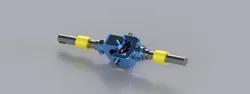
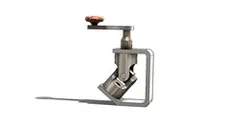
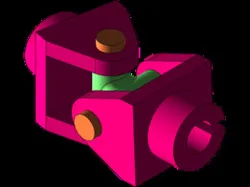
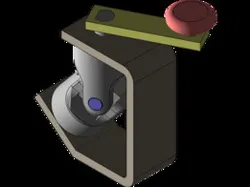
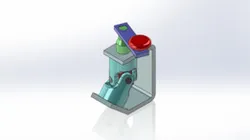
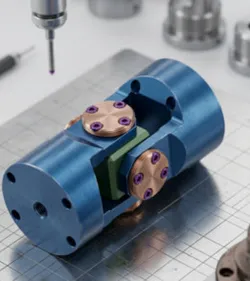
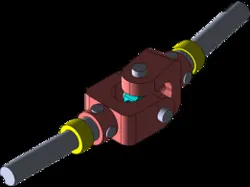
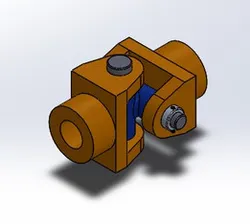
- Weiss joint consists of two identical ball yokes which are positively located by four balls. The two yokes are centered by means of a ball with a hole in the middle. Two balls in circular tracks transmit the torque while the other two preload the joint and ensure there is no backlash when the direction of loading changes. Its construction differs from that of the Rzeppa in that the balls are a tight fit between two halves of the coupling and that no cage is used. The center ball rotates on a pin inserted in the outer race and serves as a locking medium for the four other balls. When both shafts are in line, that is, at an angle of 180 degrees, the balls lie in a plane that is 90 degrees to the shafts. If the driving shaft remains in the original position, any movement of the driven shaft will cause the balls to move one half of the angular distance. For example, when the driven shaft moves through an angle of 30 degrees, the angle between the two shafts is reduced to 150 degrees. The balls will move 15 degrees in the same direction, and the angle between the driving shaft and the plane in which the balls lie will be reduced to 75 degrees. This action fulfills the requirement that the balls lie in the plane that bisects the angle of drive.
- Dimensions are approximated as a result this should be used only for demonstration purposes.
- Higher quality animations can be viewed here: http://imgur.com/a/SNhzk
Direct link to the original creator's page
More from Ahmed Afifi
Similar Models
Model Specifications
Frequently Asked Questions
Where is Weiss Joint published?
This model is published by its creator on GrabCAD. STLFinder only indexes it: the "View on GrabCAD" button above opens the original page, where the creator shares the RENDERING, SOLIDWORKS, STEP / IGES files under their own license.
What 3D printer can I use for this model?
This model is compatible with most FDM 3D printers (Creality Ender 3, Prusa MK3S+, Bambu Lab, etc.) and resin printers (Elegoo, Anycubic). Check the original page for recommended print settings and materials.
Is this 3D model free?
Yes, the creator shares it at no cost on GrabCAD. Some creators accept tips or donations.
Can I modify this file?
Check the license (see original page) on the original GrabCAD page. Most STL files can be modified using free software like Blender, TinkerCAD, or Meshmixer.